
More Introduction
What struck me about these hundreds of letters exchanged between my maternal grandparents from May 1915 to June 1916 was how independent, flirty and manipulative my grandmother was, and how my grandfather, in spite of his mushy love letters, was a master of secrecy and avoidance.
They appear to have met at a concert on Sunday, May 23, 1915, when he was 42 and she was a month shy of 27. His father had come to Portsmouth, Ohio from Prussia and was first a blacksmith then went into the grocery business and eventually the shoe and men’s furnishing business. He served on the city council and as county commissioner. This history is similar to that of his son, Frederick Benjamin Winter, the seventh son in a family of eight children that survived infancy. His great grandfather fought in the battle of Waterloo. More from his obituary in The Portsmouth Times:
Mr. Winter started his business career early. He became a road salesman for the Padan shoe firm here and traveled in the western states. He was in business with his father in the shoe and gent’s furnishings store and in 1916 became owner and operator of the Portsmouth Wharfboat Co. He remained on the river four years. The boat was once carried away by an ice floe to Manchester.
On leaving the river, he remained close to that interest by purchase of the Portsmouth Meal & Feed Co. on Front St. west of Market St from Al Vogel and continued there until after the 1937 flood, when he retired.
In the meal and feed business he expanded his acquaintanceship widely among the rural residents of Scioto Co and across the Ohio River in Kentucky.
Saw River Service Expand
During the time that Mr. Winter was wharf master, a daily service of steamboats was maintained between Portsmouth and Huntington and a similar service was established between this city and Rome. The Green Line steamers maintained a tri-weekly packet service between Cincinnati, Huntington and Charleston.
Mr. Winter was well read, not only keeping abreast of current events but finding keen interest in the works of the masters in the field of literature. He was a student of the Bible and his work as a teacher for adult Bible classes was in constant demand. He served as teacher of the George D. Selby class at Bigelow Church for 15 years and had taught also at Trinity, Second Presbyterian and Franklin Avenue Methodist many times.
He also appeared as speaker before local civic clubs and church organizations and if he had a hobby, it was reading to further improve his already well-stocked store of knowledge.
Mr. Winter had the experience of travel through nine countries of Europe, attended the World’s Fair at Brussel [sic], Belgium and the celebrated Passion Play at Oberammergau in then Upper Bavaria.
Headed Business Men
While in business in the West End he served as president of the West End business Men’s association and in more recent years, while retired, he continued to serve as treasurer for the organization.
He was a charter member of the Chamber of Commerce, serving two years on the board of directors.
For more than 20 years Mr. Winter served on various committees for the Boy Scouts. For outstanding service to boyhood he was presented the Silver Beaver award at one of the annual Scioto Area council banquets a few years ago. His last work had been on the advancement committee, where he served with Judge Ralph Stevens and others in checking on scouts for advancement at boards of review and courts of honor.
He was a member of the Civil Legion, an organization comprising civilians who worked in various capacities during World War I and was a member of The War Dads, made up of fathers who had sons in the last World war. Some years ago he was a leader in a local group that brought speakers here before a group of civic leaders.
He was a member of Aurora lodge of Masons and was a past master, having served as worshipful master in 1917.
Wed In 1916
In 1916 Mr. Winter was married to Miss Romona [sic] B. Matteson of Albion, Mich. To this union were born a son, Robert B. Winter, living in Detroit, and Mrs. Willa Louise Dallas, who resides at Yellow Springs, O. Mrs. Winter also is widely known for her work in music circles.
The population of Portsmouth, Ohio at the time of their correspondence was 30,000; there were 17 schools, 27 churches, 5 banks and 2 libraries. Thirty passenger trains and 10 steamboats arrived or departed daily. There were 44 secret societies and 9 theaters. There were about 40 factories, and 10 of them made cigars. In what was to become a shoe manufacturing capital, at this time there were only one each of shoe, shoelace and heel factories. (The wife of the minister who presided at my wedding—both old family friends—was from the Mitchell family, owners of Mitchellace shoelace company in Portsmouth.) Portsmouth’s most famous resident was Branch Rickey.
In 1915, the Panama Canal had been open for three years and the Gibson Girl look was still popular (see photo below), though dresses were shorter. The income tax amendment had come in 1913, giving rise to a growing cadre of accountants. Department stores were coming into fashion and women would spend the day shopping and hanging out in the women’s lounges, tea rooms and reading rooms that were part of the shopping experience. The midday meal was the main meal of the day, but this was starting to change with more women working outside the home.
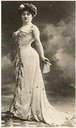
Though Victorian values prevailed, under the guise of self-improvement people began going on vacations to places where they could partake of cultural activities or spas. Motoring on a weekend afternoon grew in popularity after 1910. Railways, the typewriter, telephone, electric light, and bicycles changed the economic and cultural landscape, and the bicycle altered women’s fashion. Women’s cosmetics were in demand and with war in Europe, the American cosmetics industry surged.
They wrote to each other nearly every day, sometimes twice a day, between the end of May 1915 and June 1916, by which time she was so impatient for his proposal of marriage that she was returning his things and warning him that if he did not act NOW, it was over. A “special” must have arrived on June 17, 1916, for her letter to him on that day is full of relief and joy for their future together.
When Roma came into his life, Fred fell head over heels, but she was a risky one. She lived in another town and actually moved from town to town selling Who’s Who and other such books. She clearly loved her independence. She lived in boarding houses established for young women, and she took great care with her appearance and clothing, sewing her outfits and staying up late washing and ironing them.
He would visit her from time to time, and at some point it appears that they had sex for she is worried about her period being late, her “friend.” There are more than one hundred references by both of them to a Mr. B., or sometimes they mention his full name, Mr. Bower. Mr. B. seems to also have been in love with Roma and she frequently mentioned him in a letter when she was feeling frustrated with Fred’s recalcitrance in cementing the bond with marriage. Mr. B. had the added allure of owning a car, a “motor,” and he would visit her from time to time and seems to have had business in the towns she lived in.
The mail service was such that they could predict with great certainty exactly when the other would receive the letter, and there were two deliveries daily. Often they would send “specials,” special delivery letters, and sometimes telegrams. “Roma, dear, your letters act on me much like a tonic and you need not wonder that I crave them. When a letter from you comes everything else stops until I read it. The special you received Saturday reached you as I intended, as I did not want you to wait until Sunday.”
Their letters portray an interesting picture of their times, at least those in southern Ohio. They both seemed to enjoy musical concerts—local productions and visiting performers, as well as visiting lecturers on the Chautauqua and similar circuits. They had pretensions about being “proper” folks in the ways they dressed and in the things they did. They cared desperately how they might appear to others, and they were judgmental in their observations of others.
What I learned from Roma’s life, as told through these letters, is that she and her friends were very liberated, traveling all over, going out with young men, having a good time. Yes, they did things in groups and co-habitation was out, but they seem to have felt very free in their work and play.
While Roma was a traveling book saleswoman when the letters start, by the end, she is a music teacher in schools and she leads church choirs. She seems to be very confident about her skills and her likes and dislikes—which employment situations will please her and which will not. It appears that the book selling is more lucrative than teaching high school music, thus the need to supplement her school income with the church work.
His hesitancy to propose marriage seems to have come from a certain precariousness associated with his livelihood. My memory of my grandfather is vague. He died from cancer at 75, when I was five. He was not a large presence in the household, which was my grandmother’s domain. Roma kept a tidy house, probably with household help―my mother mentioned a woman who lived with them when she grew up, Mrs. Pancake, Lotta Pancake. Roma insisted that we brush our hair 100 times and chew our food well, “Chew, chew, chew.” She taught me to sew and darn socks, and to do things correctly—there was a right way and a wrong way. My mother, on the other hand, was not so accomplished at those things because her mother was too exacting and she could never measure up.
After her husband died, Roma worked as a housemother at an exclusive girls’ boarding school in Long Branch, New Jersey. And later, at a girls dorm at Michigan State University in Lansing. After that she sold magazines in Muncie, Indiana and whispered to my mother not to tell anyone and not to let people say that she had worked too hard. She retired and bought a small house in my home town of Yellow Springs, Ohio when I was about twelve or thirteen, and within a year, she died of a heart attack. Again, in the few days in the hospital before she died, she told my mother not to let people say she had worked too hard.
Roma always appeared to me to be an old woman. That’s why her letters and her early working life were such a revelation to me. Her skin and hair were those of an old lady. When I was young and visited her in Portsmouth, she always wore a corset when she went out, one that laced up both in front and back and served as brassiere and girdle, with elastic fasteners to hold up her stockings. I remember one very hot humid day in particular when she returned home and took off her corset, dripping wet with perspiration. Her hair was very thin and she had to spend time to make it look presentable; without the care, it looked cockeyed. She had very soft old lady skin and folds of it hung from her arms and jowls. We hated to go to church with her because she sang so loudly. We did not ordinarily go to church as youngsters, except for Easter sometimes or Christmas Eve. When Roma visited, we went more often, and the summer we were in Martha’s Vineyard going to church was a treat for her, to be among the people in Emily Post’s church in Edgartown was a special treat. And boy did she sing loud. At least she was on key. But eyes all around the room would look to see who the loud one was.
My mother told a story once that I wish now I had asked her to repeat in greater detail. When she was young, she looked through the keyhole to the bathroom where her father was bathing and she saw him splashing water over himself, cursing with each toss of water, using foul language, bad words, seeming to be very angry. What was he really doing? What did she really see? Did she look often? What did she make of it? All questions to which I do not have answers.
Was he punishing himself for having sexual feelings? Did she “forget” seeing him masturbate? And then on reading the letters and his dilly dallying about proposing marriage, was he really a closeted homosexual? That might fit with his public image as an upstanding citizen, involved with the Masons, Chamber of Commerce, Boy Scouts and a businessmen’s group, as well as being a regular Sunday School teacher.
I included their first letters in my last blog about them. Here are the next two back-and-forths. Fred did not date his letters, some of which were still in their envelopes (with the postal date), others not.
[June 2, 1915]
My Dearest Roma Belle,
Yes, and I, too, was lonesome for you last Sunday night; I can see you now in that “green” I like so well, cuddling in that sweet innocent way.
As to rain you haven’t anything on us—we are surely getting ours. With all that sleep you are getting you will become so sweet and pretty that I—well, it simply won’t be safe for me to see you again. Your generous missive dated Sunday last, awaited my home coming last evening. I am thinking seriously of accepting your kind invite to spend next Sunday with you—Saturday, Sunday and Monday would be declared a legal holiday—I meant to say a triple holiday. I want to invest in more of your biggest and sweetest smiles—my, what dividends they pay! They shine through and reach the innermost recesses of my heart and saturate my whole being with a glory, such as I have never before experienced. To me you are that shining dew drop nestling among the petals of an unfolding rose-bud—innocence personified—sending out gleams of joy to all whom you greet. What a mission—sacred and divine—is yours—a sweet and beautiful young woman—how like an oasis in the desert of human strife and care—what alight you shed in this world—too often darkened with many sins and sorrows. Allow me to quote,
There is something in your friendship,
That I know will stand the test,
Giving me a sense of safety, of security and rest,
Friend of mine, my whole life through,
I’ll be glad that I found you.
I have my first date with Miss Stockham to-morrow night—she is the young lady you met in the coupe that Sunday night. We are going to a concert at Bigelow Church.
If you were only here now so that I might whisper softly in your ear. I trust you are wearing the ring—that ring of friendship. May its sterling quality be emblematical of that pure and beautiful friendship that has grown up between us. I assure you that I appreciate the honor you do me. I was talking to Mr. Killy this evening—he asked to be remembered.
I am pleased to know that you have found such desirable and attractive places to room and board. Keep away from that charming young man from Michigan—it does not contribute to my happiness to hear about him. Tell Miss Hopper I have been thinking about her to-day—I wonder if her ears were burning? You are to be congratulated on having such a congenial co-worker and companion.
I am hoping that to-morrow’s mail will bear me a message from you—the girl for whom I feel a growing fondness.
Please do not disappoint me.
With sincere regard and esteem, I am,
Your pining friend,
F.B.W.
June second, Nineteen fifteen.
[Marion, Ohio, 9 PM, June 3, 1915]
Dear F.B.
What am I to call you? I hate Mr., and Fred doesn’t sound natural from me, so what shall it be?
I just received your letter on the afternoon mail, and was so glad to get it, altho I must admit I was expecting it, and should have been terribly disappointed had it not come. You better be careful—you know what I think about flowery letters, but will grant I am silly enough to like it. Mr. Winter I am so lonesome, I don’t know how I am going to stand it. It doesn’t seem as tho a man can get lonesome. You and Mr. Bower surely did spoil me. I tell you your kind and type are hard to find, and I don’t see anything here that even looks tempting. That Michigan man is a joke. Oh, he’s good enough if you want to be bored.
I am trying to write this in a chair swing, and everyone is kind enough to talk to me.
I am glad you are going to the concert and hope you enjoyed it. Good music, literature and art, is the essence of life.
Use your discression [sic] about telling Mr. Bower you are coming. He has asked me twice when he can come, or rather how soon, and I have evaded him, and you know I wouldn’t hurt him for the world. Don’t you think it would be nice to ask Mr. Lemon to come when you do?
Please write or phone me when you will come, and please don’t disappoint me. I am not in a condition to stand it, and don’t come later than Saturday.
Hastily and affectionately,
Roma Belle.
The train goes at seven o’clock and I must take this to the office before I go to supper—hence the haste.
June 3, 1915
[Marion, Ohio, 5:30 PM, June [4], 1915]
[Two cards.]
“Dear Friend”
That is what the girls suggested I call you.
Enclosed please find check for $10,000. [A mock check, not real.] Since you were kind enough to send me the check, I feel I must use it. Then too, I believe I was to begin on 10,000. It was really sweet and kind of you to endorse it for me. Thanks for the picture. You don’t know how those little things help to pass the lonesomeness. I told Lena that tomorrow night, I probably would not get the ride, but I hoped I’d get the end.
I’m looking forward to your coming with a great deal of pleasure, please do not disappoint me. We will indeed have a triple holiday. I just love the little friendship ring. I try to wear it all the time, but it is a little large, and if my finger is cold, it slips off without my knowledge. I am so afraid of loosing [sic] it, and that might mean “tradegy” or tragedy.
Awaiting your arrival with much interest, Lovingly,
Friday 12:30 Roma Belle
[Written upside down in the top margin of the first side of the card.] I just wrote a card to Mr. B. and told him you were coming soon.
[Enclosed with cards is a check drawn on the Security Savings Bank and Trust Co. of Portsmouth, Ohio, dated June 4, 1915, paying $10,000 to Miss Roma Belle Matteson from Fred B. Winter and then endorsed on the reverse by Miss Roma Belle Matteson. All handwriting appears to be hers.]
[June 16, 1915]
My dear little dewdrop;
You have been on my mind this blessed day. I must give vent to my feelings by sending you a line. I am wondering whether Mr. B. is with you to-night. He left for Columbus, etc. yesterday. Well, I should not worry about that, but it does give me something to think about.
I am still feasting on the memories of my lovely visit with you at Marion. I wish I could be there right now and look into your beautiful eyes and hold you and whisper to you sweet thoughts that come from the depths of my heart. Of all God’s creatures I have met none has taken such hold upon me as have you.
Your attractive and pleasing personality, your vivacious spirit and your amiable disposition coupled with your beautiful character draw me to you as the filings are drawn toward the magnet.
I am expecting to hear from you to-morrow. Will I be disappointed? Let us hope not.
I am enclosing church bulletin showing program of Miss Marting’s organ recital.
I was in the drugstore last night where the grape juice was spilled on your ‘old rose’ dress. The druggist mentioned the matter and further said he thought you were just fine. Several of my friends were inquiring about that pretty girl they saw me with. You will know how proud of you I was. Shall I “elucidate” or just “E Pluribus Uenum [sic]”?
With you as my theme I am sure I could write a prize winning thesis that would be altogether inspiring.
I notice the hour is growing late so I shall hasten to close and rush this to the station mail box.
I sincerely hope I may hear from you to-morrow.
My kind regards to Miss Hopper and all other inquiring friends,
Your bestest friend,
F.B.W.
June sixteen, Nineteen fifteen.
 QBA
QBA 