Images by Markus Lui.
About the design process.
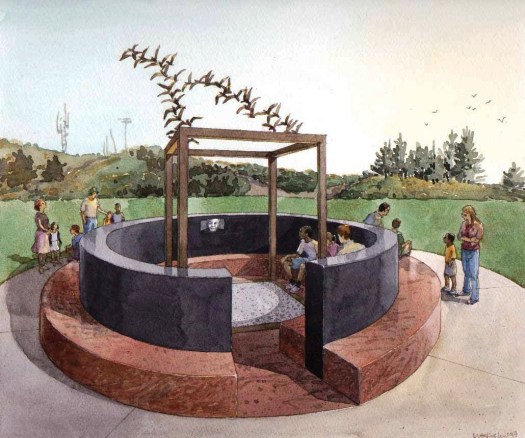
As with the World Trade Center 9/11 Memorial design, the design ideas for a Nelson Mandela Memorial to be located at Skylawn Memorial Park in San Mateo, just came to me. And it shares some elements of the Ground Zero memorial design. The requirements were that it had to be made from granite and/or bronze, be no smaller than 15’ by 15’, no larger than 20’ by 20’ and 15’ high. The height requirement gave me the most difficulty, but when I read that Robben Island had lots of birds , it came to me that flying birds would work well. (In fact, most of the birds are penguins, so I took some poetic license here.)
In 1961, I worked on the children’s psychiatric ward of Strong Memorial Hospital in Rochester, NY, and we took the children out to a fenced play area next to the hospital from time to time. One day we flew kites, and I noticed how the children were transfixed by the kites up in the sky, darting here and there so freely―in contrast to the locked and generally drab ward, world, where they spent most of their days. When I saw the rendering of the birds flying above the Mandela memorial, I thought that the Robben Island prisoners might be similarly transported beyond the dismal reality of their confines.
Design Description
The experience of visiting this memorial will inspire visitors to contemplate and appreciate the life and work of Nelson Mandela.
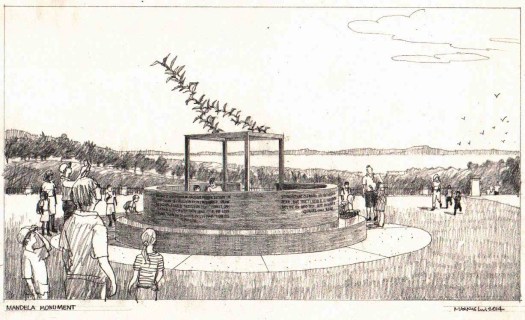
The memorial is comprised of three nested concentric circles of granite around a bronze frame suggesting Mandela’s prison cell on Robben Island. The birds in flight contrast with the confinement of the jail cell and make tangible Bono’s words on the day of Madiba’s death: “He could charm the birds off the trees.” (Time, December 5, 2013) Visitors will confront Mandela’s confinement and marvel at his ability to focus and harness his mind to such enormous benefit. From his cell, Mandela could look out on the South Atlantic Ocean and the thousands of birds that make Robben Island their home.
On entering the memorial (approximately 12’ diameter on the inside), one encounters Mandela’s engraved image above the basic facts of his life (Nelson Rolihlahla Madiba Mandela / Freedom Fighter and Statesman / July 18, 1918 – December 5, 2013). The floor of the 8’ x 7’ x 8.5’ “cell” is Georgia Gray unpolished granite; the rest of the floor (unpolished) and benches inside and out (polished) are Twilight Red granite, suggesting the South African earth and the blood of generations mixed with it. The back of the seating—defining inside and outside—is polished Charcoal Black granite. The formation in flight of the bronze birds brings to mind the two-lines-becoming-one horizontal stripe in the South African flag, and makes the memorial visible from a distance.
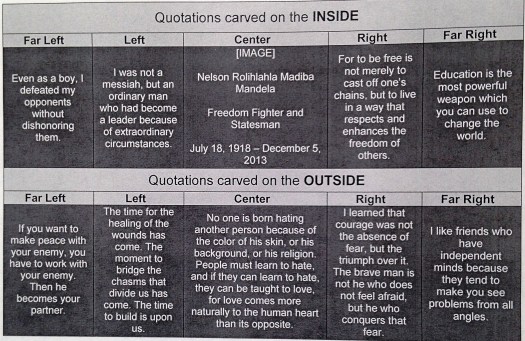
Madiba’s profound words—carved into the black granite seat backs, inside and outside—lend themselves to contemplation and thoughtful discussion. The memorial suggests both intimacy and expansiveness—closed and open, inside and outside—capturing the way we experience the world, and the memorial itself. Seated on the inside, in the presence of Mandela’s engraved image, one feels protected and at the same time full of wonder at how Mandela not only survived his 18 years at Robben Island—a total of 27½ years in prison overall—but used that time to study and think with such depth, and consequence.
In contrast, visitors seated on the outside of the memorial will be drawn to views of the ocean in the distance and the beautiful Santa Cruz mountains, opening their attention to the world at large and receiving the westerly winds that wash over the site, winds that have circumnavigated the earth.
The quotations—five on the outside, four on the inside—are carved in multiple lines that allow visitors to take them in without turning their heads. They contain lessons that Mandela learned in his lifetime and guidance in how to conduct ourselves to maximize our and others’ humanity and to promote peace and understanding in the world.
A bronze plaque mounted on a stand near the entrance provides more about Nelson Mandela’s life and work, as well as any other information the Competition Sponsor would like visitors to the memorial to know.
 QBA
QBA 